

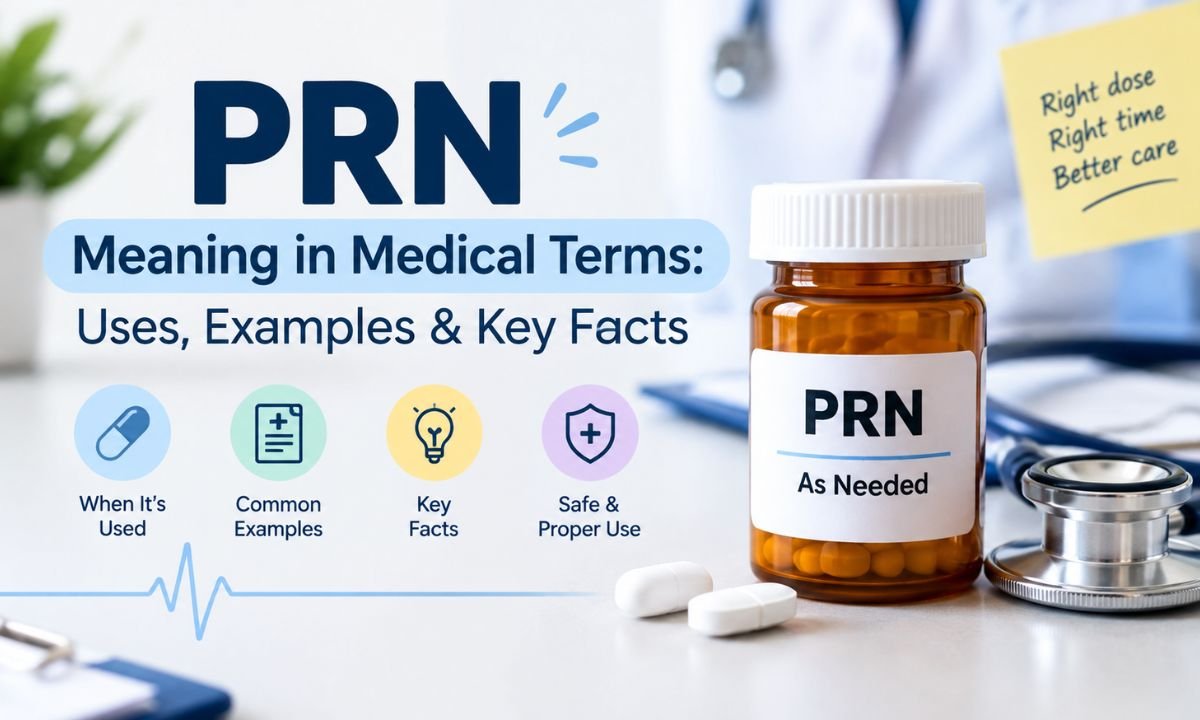
You may see PRN on a prescription or a medicine chart. It looks small, but it matters. It tells you how to take a medicine. Many people feel unsure about it. This guide makes it simple.
PRN stands for the Latin phrase pro re nata. It means “as needed.” A PRN medicine is not taken on a fixed schedule. You take it only when a symptom appears. For example, you might take it for pain, nausea, or a sudden cough.
Doctors, nurses, and pharmacists use PRN every day. You will also see it on hospital charts and pill labels. Knowing the term helps you use medicine safely. In this article, you will learn what PRN means, how it is used, and real examples. You will also get key facts to remember.
PRN Meaning in Brief: A Quick Explanation
PRN stands for “pro re nata,” a Latin phrase meaning “as needed” or “as the situation arises.” In a prescription, it tells you to use the medicine only when you have the symptom it treats.
PRN never means “as much as you like.” A proper PRN order always carries limits, such as the smallest gap between doses and a daily maximum.
Simple Examples of PRN in Use
Here are original examples of how PRN looks in everyday care:
- “Take one tablet every six hours PRN for headache.” Use it only if you have a headache.
- “Inhale two puffs PRN for wheezing.” Use the inhaler when breathing tightens.
- “Apply thin layer PRN for itching.” Use the cream when itching starts.
- “Give 5 mL PRN for fever.” A caregiver gives it only if the child has a fever, and follows the label or doctor’s dose.
If any wording feels unclear, ask your pharmacist. A short question is safer than a guess.
The Origin and Medical Background of PRN
PRN comes from “pro re nata,” which literally means “for the thing born.” In practice, it means “for the circumstance that arises.” Latin was the shared language of European medicine for centuries, so many prescription abbreviations come from it.
Real-Life Conversations: How People Use PRN
People often ask friends and family about PRN before they ask a professional. These sample chats show the typical confusion.
PRN in WhatsApp Conversations
Sara: My discharge note says “ibuprofen PRN.” Do I take it daily?
Omar: No. It means only when pain shows up. Check the daily limit on the label.
Understanding PRN in Instagram DMs
Lina: Why does my nausea tablet say PRN? Did I miss a dose?
Ayaan: You did not. PRN means take it only when you feel sick.
PRN in Everyday Text Messages
Dad: Doctor wrote allergy tablet PRN for Maya.
Mum: So only on sneezy days, within the limit on the label.
The Emotional and Psychological Aspects of PRN Use
A PRN order gives people a sense of control. You decide, within safe limits, when you need relief. For many patients that feels respectful and empowering.
It can also create worry. Some people fear taking too much, while others avoid the medicine and suffer through symptoms. Both reactions are common.
How PRN Is Used in Different Settings
PRN works in many places, but the safety rules stay the same: use it for the stated reason, respect the limits, and report how you respond.
PRN in Hospital and Clinical Settings
In hospitals, nurses usually decide when to give a PRN dose. They assess the patient, check the order, give the medicine, and then record the result.
PRN Medication Use at Home
At home, you or a caregiver makes the call. Typical PRN items include rescue inhalers, antihistamines, and short-term pain medicine.
PRN Use in Mental Health Treatment
Some anxiety, agitation, or sleep medicines are ordered PRN. In inpatient care, staff document the reason for each dose.
PRN in Workplace and Professional Settings
In healthcare jobs, PRN also describes staffing. A PRN employee works as needed, often to cover busy periods, vacations, or sudden gaps.
Context tells you which meaning applies, so check where you see it. On a prescription it means “as needed medication.” On a job posting it means “flexible, on-call shifts.”
PRN Medical Abbreviation Pronunciation
Most people say PRN as three separate letters: “pee-ar-en.” That is the normal way in clinics, wards, and offices.
The full Latin phrase “pro re nata” is said roughly as “pro ray NAH-tah.” You may also hear an English-style version, “pro ree NAY-tuh.” Either is understood in practice.
PRN Meaning in Nursing
For nurses, a PRN order is a judgment call backed by rules. The nurse confirms the symptom, checks timing since the last dose, and makes sure the daily maximum is not exceeded.
A typical nursing check looks like this:
- Assess the symptom and its severity.
- Review the order, allergies, and last dose time.
- Give the medicine as written.
- Reassess after the expected onset time.
- Document the reason, time, and response.
PRN Meaning in medical jobs
PRN also names a work arrangement. A PRN nurse, therapist, nursing assistant, or pharmacist works when the facility needs extra help instead of on a fixed weekly schedule.
Terms vary by employer, so read the contract first.
Common Misconceptions About PRN Medication
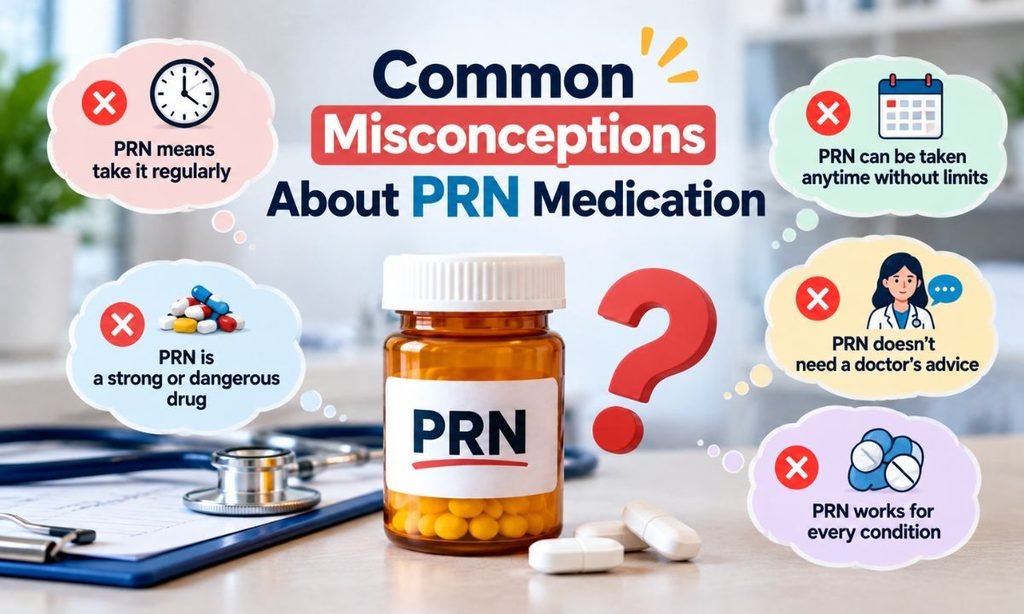
Small misunderstandings cause real mistakes. These four myths come up again and again.
Myth 1: PRN Means Taking Medication Once a Day
Wrong. PRN has no set daily schedule. You take the dose only when the symptom appears, and only within the allowed limit.
Myth 2: PRN Medication Can Be Taken in Unlimited Doses
Wrong. A PRN order includes a gap and a daily cap. Going beyond them can cause side effects or overdose.
Myth 3: PRN Medication Is Optional and Unimportant
Wrong. “As needed” does not mean “unimportant.” A rescue inhaler for asthma is PRN and can be life-saving. Use it exactly as directed.
Myth 4: Feeling Better Means You Can Stop All Medication
Wrong. PRN applies to one specific drug. Other medicines on your list may be scheduled, and you should not stop them without your prescriber’s advice.
PRN vs. Other Medication Instructions: A Comparison
PRN is symptom-driven. Most other abbreviations are time-driven.
| Abbreviation | Meaning | Schedule type |
| PRN | As needed | Symptom-based |
| QD / daily | Once a day | Fixed |
| BID | Twice a day | Fixed |
| TID | Three times a day | Fixed |
| QID | Four times a day | Fixed |
| Q6H | Every six hours | Fixed interval |
| STAT | Immediately | One-time, urgent |
| Q6H PRN | Up to every six hours, only if needed | Limited, symptom-based |
Key Takeaways About PRN Use
- PRN means “as needed,” not “as wanted.”
- Every PRN order has a reason, a gap, and a daily maximum.
- Keep a log, and tell your prescriber if you need it more often than expected.
Different Types and Patterns of PRN Medication Use
PRN orders usually match a symptom that comes and goes.
| Type | Typical trigger |
| Pain PRN | Flare-ups or post-surgery pain |
| Fever PRN | A temperature above the set level |
| Nausea PRN | Vomiting or queasiness |
| Anxiety PRN | Panic or stress spikes |
| Sleep PRN | Occasional insomnia |
| Allergy PRN | Seasonal reactions |
| Asthma PRN | Wheezing or breathlessness |
| Itch PRN | Skin irritation |
How to Respond When Someone Mentions PRN

Your reply depends on the mood and the relationship. Here are simple options.
Casual Responses to PRN
- “That just means only when you need it.”
- “Take it if the symptom shows up.”
Funny Responses to PRN
- “PRN is doctor code for ‘don’t overdo it.’”
- “Think of it as the ‘only if needed’ button.”
Mature and Confident Responses
- “Stick to the limit on the label and you’ll be fine.”
- “It treats symptoms, so it isn’t a daily habit.”
Private and Respectful Responses
- “Your pharmacist can explain it in two minutes.”
- “I’m glad you asked, and I’ll keep it between us.”
PRN Usage Across Different Regions and Cultures
PRN is used worldwide, but patient familiarity varies with language, training, and local habits.
PRN Usage in Western Countries: US, UK, and Canada
PRN is common in US and Canadian hospitals and pharmacies. In the UK, “when required” is often written in full, but PRN is still widely understood by clinicians.
PRN Usage in Asian Countries
Many hospitals use English abbreviations in charts, even when staff speak other languages. Patients may rely on spoken instructions, so a pharmacist’s explanation matters.
PRN Usage in Middle Eastern Countries
Healthcare teams are often international, so Latin and English abbreviations like PRN are routine in clinical records. Patients usually benefit from a verbal explanation in their own language.
PRN in Global Online Communication
People now search for medical terms before asking a professional. Clear, accurate pages help, but they cannot replace your prescriber’s directions for your own case.
Conclusion
PRN means “as needed,” taken from the Latin “pro re nata.” It tells you to use a medicine when a symptom appears, within a stated gap and daily limit.
It is not once-daily, not unlimited, and not unimportant. In jobs, PRN also means flexible, on-call work.
If a PRN label confuses you, ask your pharmacist or doctor before taking the next dose. Understanding PRN keeps your treatment safer and simpler.
Frequently Asked Questions
What Does PRN Stand for in Medical Terminology?
PRN stands for “pro re nata,” a Latin phrase meaning “as needed” or “as the situation arises.”
Does PRN Mean Taking Medication Every Day?
No. PRN means you take the medicine only when the symptom appears, not on a daily schedule.
Can PRN Medication Be Taken Daily?
Only if your symptom occurs daily and you stay within the prescribed limits. Tell your prescriber if daily use becomes routine.
Does PRN Mean Medication Is Optional?
No. PRN medicine is still prescribed for a reason and must follow the stated limits.
What Does a PRN Nurse Do?
A PRN nurse works flexible, as-needed shifts to cover staffing gaps, instead of a fixed schedule.
Why Do Doctors Prescribe PRN Medication?
Doctors use PRN for symptoms that come and go, so patients avoid unnecessary medicine.
Is PRN Medication Safe to Use?
It is generally safe when used exactly as prescribed, within the stated gap and daily maximum.