

You get a message that says only “hy” and nothing else. Is it a typo, a new slang word, or a hidden code? Don’t worry, the answer is much simpler than it looks.
In most chats, HY is a quick, casual greeting that works like “hey” or “hi.” This guide explains its meaning, origin, tone, replies, and the other places you might see those two letters.
Whether the message comes from a friend, a crush, or a stranger, reading it correctly saves you from awkward replies. You will also find real chat examples, a handy comparison table, and simple answers to the most common questions.
HY Meaning in Text: Quick Explanation
HY means “hey” in most text messages. It is a shortened, informal greeting people send to start a chat or get someone’s attention.
Short Definition
- Full form: Hey (sometimes read as “hi”)
- Type: Informal greeting or chat abbreviation
- Tone: Friendly, relaxed, low-effort
- Where it appears: WhatsApp, Instagram, Snapchat, TikTok, SMS, and Discord
Sample Uses
- “hy, are you free tonight?”
- “Hy! Long time no see 😄”
- “hy 👋” (sent just to say hello)
In every case, the sender is opening a conversation or reaching out in a light, easy way.
Why do people choose HY over “hey”? The reasons are simple:
- It is faster to type on a phone.
- It feels relaxed and low-pressure.
- It matches the short, quick rhythm of modern chats.
Where HY Came From: Origin & Background
HY started as a typing shortcut. People dropped the middle letter of “hey” to save time on small keyboards and in fast chats.
It may also come from simple typos. The “e” and “y” sit close to other keys, and quick thumbs sometimes skip a letter. Over time, many users stopped fixing it and the shorter form stuck.
No single person invented it, and no official source explains it. Like many greetings online, it spread naturally as people copied what they saw in group chats and comment sections.
Today the spelling is widely recognized, though some readers still see it as a typo. That is why tone and context matter more than the letters themselves.
Real-Life Chat Examples
Seeing HY in context makes its tone easier to understand. Here are four original examples.
WhatsApp Chat
Nadia: hy Omar: Hey! Everything okay? Nadia: Yep, just wanted to ask about tomorrow’s plan.
Nadia uses HY to open a conversation before getting to her real question.
Instagram DM
Jay: hy 👋 loved your latest post Ava: Aww thank you! 😊
Here HY is friendly and warm. The wave emoji adds a smile.
Text Message Exchange
Sam: hy Lena: hy! what’s up? Sam: nothing much, you?
Both people use the same casual style, so it feels natural and balanced.
TikTok Comments
User A: Hy everyone, first time here!
User B: Welcome! 🎉
Creators and viewers often use HY to greet a community quickly.
Emotional & Psychological Meaning of HY
A short greeting can carry more feeling than you expect. With no voice or face, readers fill in the tone themselves.
Depending on the sender and situation, HY can suggest:
- Friendliness: “I’m happy to talk to you.”
- Low pressure: “No big agenda, just saying hello.”
- Curiosity: “Are you around?”
- Shyness: A nervous way to start a chat with someone new.
- Fondness: A soft, caring opener from a partner or close friend.
Because the message is so short, small details matter. “hy 😊” feels warm, while “hy.” can feel flat or distant.
How HY Is Used in Different Contexts

On Social Media
On public platforms, HY works as a fast greeting in comments, replies, and live chats. Creators use it to welcome viewers, and fans use it to get noticed. 💬
What Does HY Mean on Snapchat?
On Snapchat, HY simply means “hey.” People send it as a quick snap caption or chat message to check in or start a streak conversation.
Among Friends & Partners
Friends use HY casually, often several times a day. It signals comfort and closeness because no one feels the need to write a full greeting.
Partners may use it as a sweet check-in, especially when they miss each other. Adding a heart or smiling emoji makes the tone clear.
What Does HY Mean in a Text From a Guy?
When a guy texts “hy,” it usually means “hey.” It can be a friendly greeting, a simple check-in, or a low-effort way to start talking.
Do not assume romantic interest from those two letters alone. Look at how often he texts, whether he follows up with a question, and what emojis he uses.
For example, “hy, how was your exam?” shows real interest in your day. A bare “hy” with no follow-up may simply be a casual hello.
In Work or Professional Settings
HY is too casual for most workplaces. In a quick chat with a close teammate it may pass, but in emails or messages to managers, clients, and professors, it can look careless.
Choose a polished greeting instead:
- “Hello, Ms. Khan,”
- “Hi team,”
- “Good morning,”
Casual vs Serious Tone
| Situation | Is HY Okay? | Better Choice |
| Friends and family | Yes | HY, hey, or hi |
| Dating or crushes | Yes, with warm emojis | Hey 😊 |
| Group chats | Yes | HY or hi all |
| Teachers, bosses, clients | No | Hello or Good morning |
| Formal emails | No | Dear + name |
| Serious or sad topics | Not ideal | A caring, full sentence |
Common Myths About HY
Myth #1: HY Has a Hidden Meaning
HY does not hide a secret code. In nearly all cases it is just a quicker way to write “hey.”
Myth #2: HY Is Always Romantic
Not true. People send HY to friends, classmates, relatives, and even followers they have never met. Context decides the mood.
A classmate who texts “hy” before asking about homework is not flirting. They just want to start the chat politely.
Myth #3: HY Works in Professional Emails
It does not. Formal messages need a clear greeting and a respectful tone, so HY should stay in casual chats.
Myth #4: HY Is the Same as Other Slang
HY is a greeting, not a reaction or a question. It differs from slang like “HMU” (hit me up) or “WYD” (what are you doing), which ask for something specific.
Does HY Have Other Meanings?
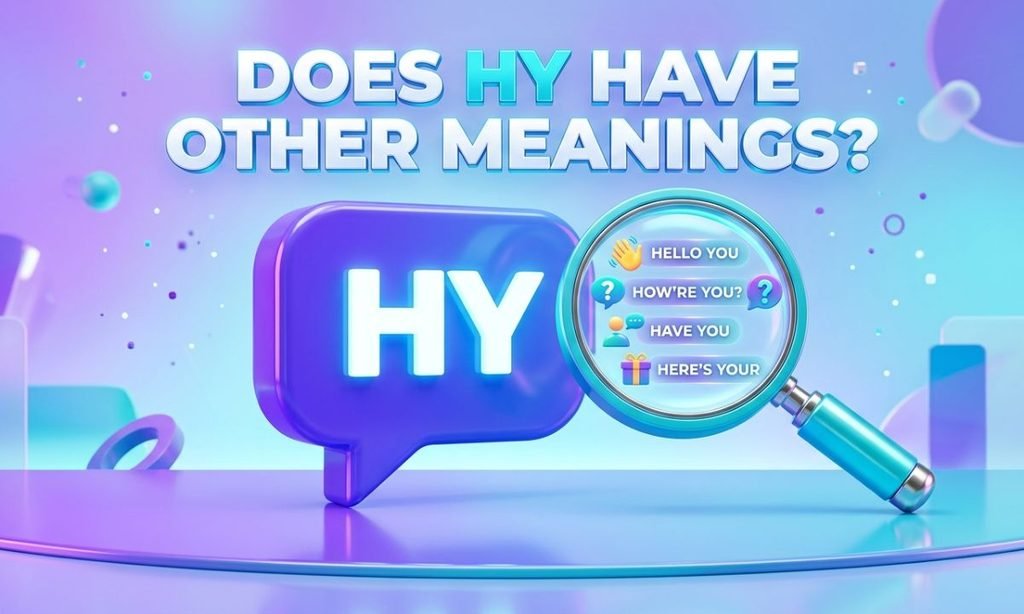
Yes, but only outside everyday texting. Always check the setting before assuming.
HY Meaning in Finance
In finance, HY stands for “high yield.” It refers to high-yield bonds, which pay higher interest because they carry greater risk. You may see it in market reports, such as “HY bond fund” or “HY credit spreads.”
HY Meaning in Medical Terms
In medicine, HY is not a common standalone abbreviation. Clinics and hospitals use many short forms, and their meaning depends on the practice. If you see HY on a medical record or prescription, ask your doctor or pharmacist what it means instead of guessing. Guessing about health information can lead to real mistakes.
HY Comparison Table
Here is how HY compares with similar greetings.
| Term | Meaning | Tone | Best For |
| HY | Hey | Casual, quick | Friends, DMs, comments |
| Hey | Informal hello | Friendly | Most casual chats |
| Hi | Standard hello | Neutral, polite | Almost any situation |
| Yo | Very informal hello | Playful, bold | Close friends |
| Sup | What’s up? | Relaxed | Quick check-ins |
| Hello | Formal greeting | Polite | Work and new contacts |
Main Takeaway
HY is a lazy-but-friendly version of “hey.” If you are unsure how your reader will take it, “hi” or “hello” is always safer.
Think of it like a wave across a room. It is friendly and quick, but it works best with people who already know you. For new contacts, a slightly fuller greeting shows respect and makes a better first impression.
HY Variations and Related Terms
Small spelling changes can shift the vibe. Here are ten you will see often.
1. HYY
Adds extra warmth and energy. It feels more excited than plain “hy.”
2. HYYY
Even more playful. People use it with close friends or crushes.
3. HEY
The full, standard version. Friendly and widely understood.
4. HI
Neutral and polite. Works almost anywhere.
5. HEYY
A stretched “hey” that sounds affectionate and relaxed.
6. HIII
Cute and cheerful, often used with emojis.
7. YO
Short and cool. Common among friends, especially younger users.
8. SUP
Short for “what’s up?” It invites a quick reply.
9. HELLOOO
Dramatic and funny. It can also mean “are you there?” if someone is slow to answer.
10. WASSUP
A casual, playful spelling of “what’s up?”
How to Reply When Someone Says HY
Match the other person’s mood, then keep the chat moving.
Casual Replies
- “Hey! What’s up?”
- “hy! how’s your day going?”
- “Hi! Good to hear from you.”
Funny Replies
- “Hy yourself 😄”
- “Oh look, someone remembered I exist!”
- “Took you long enough, hello!”
Mature and Confident Replies
- “Hi! How have you been?”
- “Hello, good to hear from you. What’s on your mind?”
- “Hey, glad you messaged.”
Polite and Private Replies
- “Hi, sorry, who is this?” (for unknown numbers)
- “Hello! Can I help you with something?”
- “Hi, I’m busy right now, can we chat later?”
If a stranger sends HY and you feel uneasy, you never have to answer. Block or report if the messages continue. 🛡️
A good habit is to reply in the same style as the sender. If they write casually, answer casually. If they seem serious, reply with a full, kind sentence.
HY Usage Across Regions & Cultures
HY is not tied to one country, but style and formality differ.
Western Culture
In the US, UK, Canada, and Australia, short greetings like HY are common among teens and young adults. People rarely expect formal greetings in casual chats. 🇺🇸🇬🇧
Asian Culture
In many Asian countries, young users mix English slang into local-language chats, so HY appears often. With elders or teachers, however, respectful, complete greetings are usually preferred.
Middle Eastern Culture
English greetings are common in mixed-language chats, but many people also use Arabic, Urdu, or Persian greetings, which can be warmer and longer. Politeness and respect often shape how casual someone feels comfortable being.
Global Internet Usage
Online communities mix many languages and habits. HY is easy to understand almost everywhere English is used, though not all users know it. When in doubt, spell it out.
Conclusion
HY is a short, casual greeting that most often means “hey.” It is friendly, quick, and common in texts, DMs, and comments, but it can also appear as a typo.
Remember that tone comes from context, emojis, and your relationship with the sender. Keep HY for relaxed chats, use “hello” for work, and check the setting if you see it in finance or medical papers.
Frequently Asked Questions
Here are quick answers to the questions people ask most about this small greeting.
Each response is short on purpose so you can scan it fast. For more detail, check the sections above.
What is the meaning of HY in a text message?
HY usually means “hey,” a casual greeting. People send it to say hello or start a conversation.
Does HY mean the same as Hey?
Yes, in texting HY is a shortened or misspelled version of “hey.” The meaning and friendly tone are the same.
Is HY considered slang?
Yes, it is informal chat shorthand. It belongs in casual messages, not formal writing.
Does HY have any other meanings?
Yes, in finance it stands for “high yield.” In medicine it is not a standard abbreviation, so ask a professional if you see it.
Is HY considered rude?
No, it is generally friendly. It may feel flat if sent alone in a tense or formal situation.
Is it appropriate to use HY in professional emails?
No. Use “Hello” or “Hi” followed by the person’s name instead.
Why do people write HY instead of Hey?
It is faster to type, and many people also drop the “e” by accident. Over time the shorter version became common.