


Seen “fr” in a message and wondered if it is a typo? It is not. FR is one of the most popular slang terms in modern texting, and it shows up in nearly every chat app. Once you spot it, you will start noticing it everywhere.
FR stands for “for real.” People use it to agree, to stress that they mean something, or to ask if something is true. The tone changes with the sentence around it.
In this guide, you will learn what FR means in text, where it came from, and how to use it. You will also find examples, similar slang, and smart replies.
FR Meaning in Text: A Quick Explanation
FR means “for real.” It is used to show honesty, strong agreement, or surprise. You can type it in lowercase (“fr”) or in capitals (“FR”), and the meaning stays the same. Think of it as a quick way to say “I’m not kidding” without typing the whole phrase.
What Does FR Mean in Texting?
In texting, FR adds emphasis. It tells the reader, “I am being serious,” or “I totally agree with you.” It works like a verbal nod.
| Use | Meaning | Example |
| Agreement | “I feel the same” | “This song is so good.” “fr” |
| Emphasis | “I mean it” | “I’m so tired fr” |
| Question | “Is that true?” | “You got the job? fr?” |
| Honesty | “No joke” | “fr, that was my best day” |
Common Examples of FR in Messages
Here are everyday ways people use it:
- “That test was hard fr.”
- “I miss summer fr ☀️”
- “Are you coming tonight? fr?”
- “You deserve a break, fr.”
Notice that FR can sit at the start, middle, or end of a sentence, or stand alone as a reply.
The Origin and History of FR Slang
FR is a short form of the phrase “for real,” which people have said in spoken English for decades. It was common in American slang long before smartphones, often used to mean “truly” or “seriously.”
When texting and chat apps grew, people shortened phrases to save time. “For real” became “fr,” just like “be right back” became “brb.” The short form felt quick, casual, and friendly.
How Social Media Popularized FR
Social media pushed FR into the mainstream. Short captions, fast comments, and viral videos made brief reactions very useful. Creators and fans on platforms like TikTok, Instagram, and Snapchat repeated it, and it spread worldwide.
The doubled form, “fr fr,” also grew through memes and comment sections. Today, young people and many adults use it daily.
FR in Real-Life Conversations
FR isn’t just for texting, since many people now say “fr” out loud to agree or show they mean it. A friend might say “That movie was so good, fr,” or ask “fr?” when surprised. It suits casual chats, but in formal settings, “for real” or “honestly” is safer.
FR in WhatsApp Chats
On WhatsApp, FR often shows agreement between friends or family.
- Friend 1: “This traffic is crazy.”
- Friend 2: “fr, I’ve been stuck for an hour 😩”
It keeps the chat warm and relaxed.
FR in Snapchat Chats
Snapchat chats move fast, so replies are short. FR works well as a quick reaction.
- Snap: “Just finished my exam!!”
- Reply: “fr?? congrats 🎉”
Here, the question mark turns it into a surprised “really?”
Using FR in Instagram Direct Messages
In Instagram DMs, FR often replies to reels, memes, or stories.
- “Your new haircut looks great fr 🔥”
- “fr, I needed that reel today”
It feels friendly and supportive in this setting.
FR in TikTok Comments
TikTok comments love short, punchy phrases. FR signals that you relate to the video.
- “Monday energy fr 😂”
- “This recipe is perfect fr”
A big pile of “fr” comments usually means a video hit a shared feeling.
FR in Everyday Text Messages
In regular texting, FR shows up in plans, jokes, and quick agreements.
- “Dinner at 8? fr I’m starving”
- “Thanks for helping me today, fr”
It softens the message and makes it sound human.
The Emotional and Psychological Meaning of FR
FR often signals connection. When someone replies “fr,” they are telling you, “I get you.” That small agreement can make a chat feel closer and more honest.
People use FR for several emotional reasons:
- To show empathy. It tells a friend their feelings are understood.
- To stress honesty. It adds weight to a statement.
- To express surprise. “fr?” shows disbelief or curiosity.
- To keep things casual. It makes serious topics feel less heavy.
Since text has no voice or face, FR helps carry tone. It fills the gap that body language usually fills in person.
FR Meaning from a Girl or a Boy
The meaning is the same no matter who sends it. FR is simply “for real.”
Still, people read it a little differently:
- From a girl: It often shows empathy or excitement, especially when paired with emojis.
- From a boy: It is often a short, relaxed agreement, such as “fr bro.”
These are only habits, not rules. Context and the person’s usual texting style matter more than gender. In a romantic chat, “fr?” can also mean the person wants honest reassurance. 👀
How FR Is Used in Different Contexts
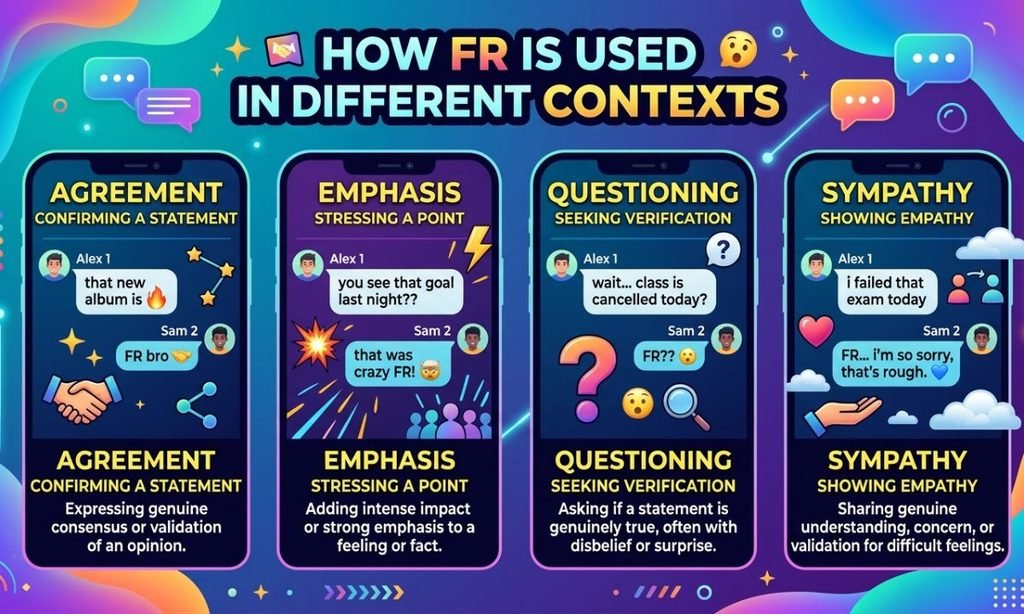
FR changes its feel with the setting. In texts and comments, it adds emphasis or agreement (“that game was great, fr”), and “fr?” asks if something is true. It suits friends, but in formal emails or meetings, “for real” or “honestly” is safer.
FR on Social Media Platforms
On social media, FR is used in comments, captions, and replies. It signals that you relate to a post. Creators also use it in captions to sound honest, such as “Best day ever fr.”
FR Among Friends and in Relationships
Among friends, FR is friendly and normal. In relationships, it can show care or honesty.
- “I love spending time with you, fr ❤️”
- “fr? You really did that for me?”
Used sincerely, it makes messages feel genuine.
Using FR in Professional Settings
FR is too casual for most professional messages. Avoid it in emails, reports, and client chats. If your team uses a relaxed chat, it may be fine with close coworkers, but use a full phrase when unsure.
Try instead: “I agree completely,” or “That is a fair point.”
FR in Casual and Serious Conversations
| Situation | Is FR okay? | Why |
| Chatting with friends | ✅ Yes | Relaxed and natural |
| Group chat jokes | ✅ Yes | Fits the tone |
| Sharing sad news | ⚠️ Careful | Can sound too casual |
| Work emails | ❌ No | Too informal |
| School assignments | ❌ No | Not formal language |
Common Misunderstandings About FR
Because FR is short, people sometimes misread it. Here are the biggest mix-ups.
Confusing FR Slang With the Country Code for France
“FR” is also the official code for France, used on flags, websites (.fr), and travel documents. In a chat about travel or domain names, it may mean France. In a normal conversation, it almost always means “for real.” Check the topic to be sure. 🇫🇷
Assuming FR Always Expresses Agreement
FR does not always mean “yes.” It can also show surprise (“fr?”), emphasis (“I’m tired fr”), or even mild sarcasm if the tone is flat. Look at the sentence around it.
Using FR in Formal Communication
Some people use FR in places where it does not fit, like job applications or business emails. This can look careless. Save it for casual chats and keep formal writing clear and complete.
FR vs. Similar Slang Terms: A Comparison
FR belongs to a group of “honesty” slang terms. They are similar but not identical.
Key Differences Between FR and Related Expressions
| Term | Meaning | Tone | How it differs from FR |
| FR | For real | Casual, friendly | Short, flexible, works as agreement or question |
| No cap | No lie | Confident | Stresses a claim is true |
| Deadass | Seriously | Strong, direct | Heavier, more intense |
| TBH | To be honest | Neutral | Introduces an honest opinion |
| NGL | Not gonna lie | Casual | Prepares for a candid statement |
| IDK | I don’t know | Neutral | Shows uncertainty, not emphasis |
In short: FR is the most flexible. It can agree, emphasize, or ask for confirmation, while most others only do one job.
FR Variations and Similar Expressions
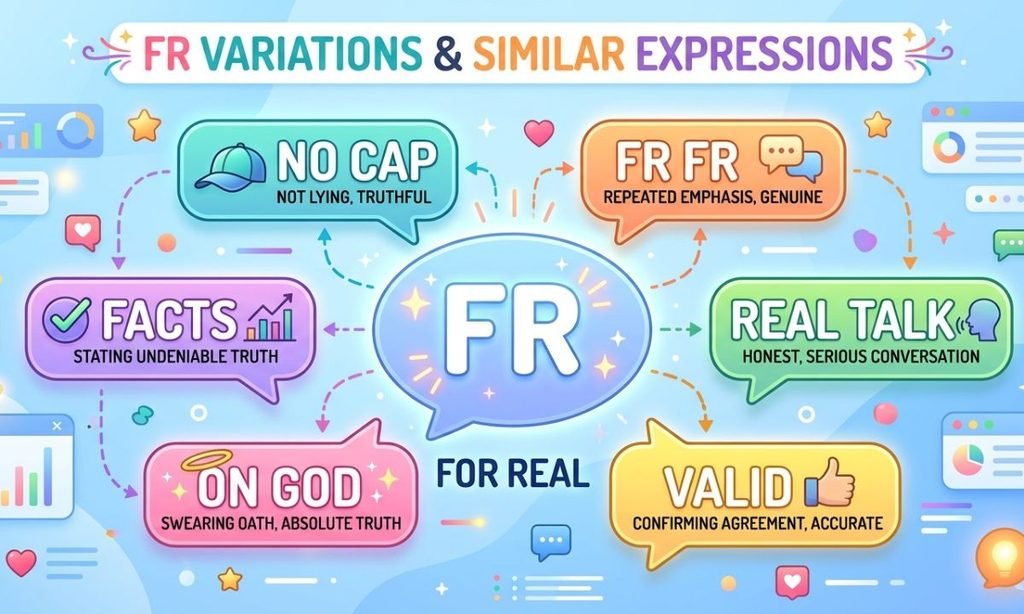
FR has a few common variations, like “frfr” for extra emphasis, “no cap” for “no lie,” and “ong” for “on God.” Similar expressions like “deadass” also add honesty or strong agreement. Pick the one that sounds natural for your friend group and platform.
1. FR FR — Emphasizing Sincerity
Doubling the phrase adds extra weight. Example: “I’m so proud of you fr fr.” It means “I truly mean it.”
2. FR? — Asking for Confirmation
A question mark turns it into “really?” Example: “We won the game. fr?” It shows surprise or doubt.
3. For Real — The Full Form of FR
This is the original phrase. Example: “For real, thank you.” It sounds slightly softer than the short form.
4. No Cap — Expressing Honesty
It means “no lie.” Example: “That pizza was the best, no cap.” Gen Z uses it a lot.
5. Deadass — Emphasizing Seriousness
It means “completely serious.” Example: “I’m deadass moving next month.” It is stronger than FR.
6. TBH — To Be Honest
It introduces an honest opinion. Example: “TBH, I liked the first one more.” It is common and easy to understand.
7. NGL — Not Gonna Lie
It signals a candid statement. Example: “NGL, I’m nervous.” It feels open and relaxed.
8. Honestly — Expressing Genuine Thoughts
This is the full-word version and is fine in most settings. Example: “Honestly, I think you made the right call.” It also works at work.
9. Legit — Describing Something Genuine
It means real or authentic. Example: “That seller is legit.” It can also mean “really good,” as in “That show is legit amazing.”
10. No Joke — Emphasizing the Truth
It tells the reader you are not kidding. Example: “No joke, that was the scariest ride ever.” It is easy for adults to use too.
How to Reply When Someone Uses FR
Match your reply to the mood of the message. If the sender is excited, be excited back. If they are sharing something personal, respond with care.For a casual FR, a quick “fr” or “same, fr” keeps the conversation going. If they use “fr?” as a question, answer it directly with something like “yes, fr” or “no cap, I’m serious.”
Casual Responses to FR
- “Right?! Same here.”
- “Yeah, totally.”
- “I know, it’s wild.”
Funny and Playful Replies to FR
- “fr fr no cap 😂”
- “Say it louder for the people in the back!”
- “We should start a club for this 😎”
Mature and Confident Responses to FR
- “I appreciate you being honest with me.”
- “That makes sense. Let’s talk about it.”
- “Thanks for sharing that.”
Polite Replies That Respect Personal Boundaries
- “Thanks for telling me. Take your time.”
- “I understand. No pressure at all.”
- “I’m here whenever you want to talk.”
Tip: If the “fr?” feels like a doubt, answer clearly: “Yes, fr, it’s true!” 👍
FR Slang Across Different Regions and Cultures
FR began in English-speaking online spaces like gaming chats, Twitter, and TikTok, and is now common on Instagram, Snapchat, and WhatsApp in South Asia. The meaning of “for real” stays the same everywhere, though it is often mixed with local languages. Tone varies by region, so it fits best with people who share a similar online style.
FR Usage in Western Cultures
In the US, UK, Canada, and Australia, FR is very common among teens and young adults. It also appears in music, memes, and online videos.
FR Usage in Asian Cultures
In many Asian countries, young people mix English slang with local languages in chats. FR is understood in online spaces, especially among students and gamers. Formal settings still prefer polite, complete language.
FR Usage in Middle Eastern Cultures
In the Middle East and South Asia, many young people mix English abbreviations into Arabic, Urdu, or Hindi messages. FR is mostly used among friends and peers. With elders, people usually choose respectful, complete sentences.
How FR Is Used Across the Global Internet
Online, FR appears in gaming chats, comment sections, and group chats. Because slang travels fast, it is understood across many communities. The tone always depends on the people and the platform.
Conclusion
FR means “for real,” and it is a simple way to agree, show honesty, or ask if something is true. Its tone depends on context, punctuation, and emojis. It is short, quick to type, and understood by almost everyone in online chats.
Use it in casual chats with friends, and choose clear words in formal settings. When you read it, check the situation before reacting. Used well, FR makes your messages feel real and relatable. Keep it natural, and it will become an easy part of your everyday chat style.
Frequently Asked Questions
What Does FR Mean in Text Messages?
FR means “for real.” It shows agreement, honesty, or surprise. It is one of the most common slang terms in modern texting.
What Does FR Mean on TikTok?
On TikTok, FR means “for real” and shows you relate to a video or comment. It is a quick way to say “this is so true.”
Is FR Considered Rude or Offensive?
No. FR is a friendly, casual term and is not rude in normal chats. It only sounds sharp if paired with a harsh message.
What Does FR FR Mean in Texting?
“FR FR” means “for real, for real.” It adds extra emphasis and sincerity. People use it to show they truly mean what they said.
Can Adults Use FR in Everyday Conversations?
Yes. Adults can use it in casual chats with friends and family. It is not limited to teens anymore.
Can FR Also Stand for France?
Yes. FR is the country code for France, but in chats it usually means “for real.” The surrounding words make the meaning clear.
Is It Appropriate to Use FR in the Workplace?
Usually no. Use full phrases like “I agree” in professional messages. If your team chats casually, a quick “fr” may be fine