

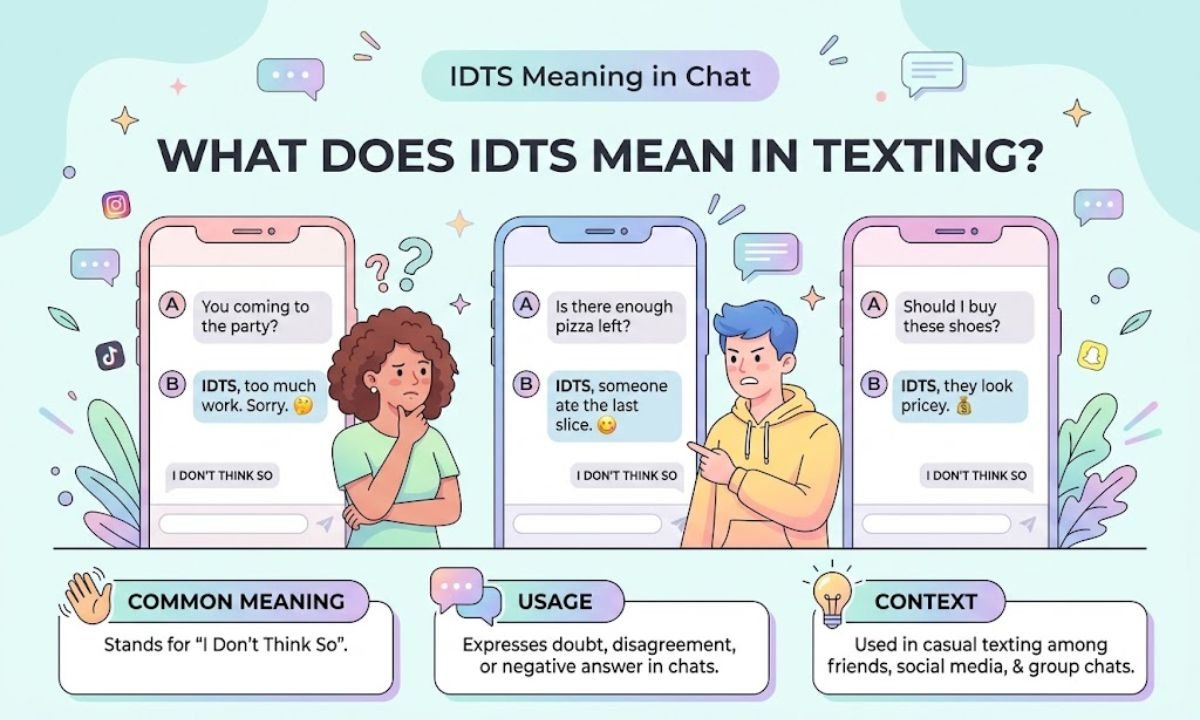
IDTS is one of those texting abbreviations that shows up constantly in group chats, DMs, and comment sections, yet plenty of people still pause and wonder exactly what it means. In most cases, IDTS stands for I Don’t Think So, and people type it to express doubt, mild disagreement, or a soft way of saying no.
The tone behind it can shift depending on punctuation, emojis, and who is texting whom. This guide breaks down the full form, the different shades of meaning, real chat examples, and how to reply when someone sends it your way.
IDTS Meaning in Chat: The Direct Answer
IDTS Stands for I Don’t Think So
IDTS is a short way of typing I Don’t Think So, used when someone wants to express doubt or disagreement without writing a full sentence.
It Is an Informal Texting Abbreviation
Like LOL or BRB, IDTS belongs to the family of casual internet initialisms built for speed rather than formality.
The Meaning Rarely Changes Across Platforms
Whether it appears on Snapchat, Instagram, or in a regular text thread, IDTS almost always keeps the same core meaning.
IDTS Meaning in Text at a Glance
| Term | Meaning |
| IDTS | I Don’t Think So |
| Type | Texting and chat abbreviation |
| Main use | Doubt, disagreement, or a soft no |
| Tone | Casual, skeptical, sometimes playful |
| Common platforms | Texts, DMs, group chats, comments |
| Best avoided in | Emails, formal writing, professional messages |
What Does IDTS Stand For, Letter by Letter
Breaking the abbreviation down makes the full form easy to remember.
- I stands for I
- D stands for Don’t
- T stands for Think
- S stands for So
Put together, the phrase reads I Don’t Think So, and that full form stays consistent across nearly every chat platform and slang dictionary.
The Different Shades of IDTS Meaning
IDTS is not a one-note phrase. Depending on the sentence around it, the same three letters can carry slightly different meaning.
Expressing Uncertainty
Sometimes IDTS simply signals that the sender is not fully sure about something, closer to maybe not than a firm no.
Expressing Disagreement
Other times it directly pushes back on an opinion or claim someone else just made in the conversation.
Expressing a Soft No
IDTS often softens a refusal, making it feel gentler than typing a blunt no on its own.
How People Actually Use IDTS in a Chat
IDTS tends to appear in a few predictable conversation patterns.
- As a quick reply to a yes or no question
- As a reaction to a bold claim or prediction
- As a gentle way to shut down a suggestion
- As a one word response that keeps the chat moving without conflict
Is IDTS Rude or Polite? It Depends on Tone
When IDTS Sounds Friendly
Paired with a laughing emoji among close friends, IDTS usually reads as playful rather than harsh.
When IDTS Sounds Dismissive
Sent alone with no punctuation or emoji, it can come across as blunt or cold, especially with someone you do not know well.
When IDTS Sounds Sarcastic
In a joking exchange, IDTS can poke fun at an obviously exaggerated statement rather than express real doubt.
How Emojis Change the Tone
Adding an emoji like a laughing face or a thinking face softens the message, while a plain IDTS with a period can feel more final.
Real IDTS Texting Examples
Seeing the abbreviation inside real conversations makes the meaning click faster than any definition alone.
- Friend: Do you think it’s going to rain later. You: IDTS, the sky looks clear.
- Group chat: We are definitely winning this game. Reply: IDTS lol.
- Flirty chat: I bet you can’t beat my high score. Reply: IDTS, watch me.
- Prediction: This movie is going to flop. Reply: IDTS, the trailer looked great.
- Question: Is the store still open right now. Reply: IDTS, it’s already past nine.
IDTS Meaning on Snapchat, Instagram, and TikTok
On Snapchat
Snapchat conversations use IDTS the same way as regular texting, usually as a fast reply inside a snap or chat thread.
On Instagram
In Instagram DMs and comment sections, IDTS often responds to opinions, predictions, or debates under a post.
On TikTok
TikTok comment sections use IDTS to push back on a claim made in a video or by another commenter.
How to Respond When Someone Sends You IDTS
- Friendly reply: Fair enough, why do you think that.
- Funny reply: Rude, but okay, prove me wrong then.
- Flirty reply: We will see about that, challenge accepted.
- Serious reply: I hear you, but here is why I still think it will happen.
- Disagreement reply: I actually think you’re wrong, here is why.
IDTS vs Similar Texting Abbreviations
| Abbreviation | Full Form | Main Difference from IDTS |
| IDK | I Don’t Know | Shows lack of information, not disagreement |
| IMO | In My Opinion | Introduces a viewpoint rather than doubt |
| IDC | I Don’t Care | Shows indifference rather than skepticism |
| TBH | To Be Honest | Signals honesty rather than doubt |
| NGL | Not Gonna Lie | Introduces a candid admission, not disagreement |
When to Use IDTS and When to Avoid It
Casual settings are where IDTS fits naturally, including chats with friends, informal group threads, and light social media comments. It works well whenever the conversation is relaxed and both people understand texting shorthand.
On the other hand, professional emails, formal business messages, academic writing, and any situation where your wording could be misread are all places to skip it entirely. In those settings, a clear full sentence protects against confusion far better than an abbreviation ever could.
Frequently Asked Questions
What does IDTS mean in text?
IDTS stands for I Don’t Think So and expresses doubt, disagreement, or a soft no.
What does IDTS stand for?
It stands for I Don’t Think So, spelled out from its four letters.
Is IDTS a slang term?
Yes, it is an informal internet and texting slang abbreviation used mainly in casual chats.
Is IDTS rude?
Not usually, though tone, punctuation, and emojis can make it sound sharper or softer.
How do you reply to IDTS?
You can agree, ask why, joke back, or explain your own reasoning depending on the mood of the chat.
What does IDTS mean on Snapchat?
It carries the same meaning there as anywhere else, expressing doubt or a casual no.
Can IDTS mean something else?
Rarely, in niche contexts, but in everyday chat and texting it almost always means I Don’t Think So.
Conclusion
IDTS means I Don’t Think So in the vast majority of texting and chat conversations, and it works as a quick, low pressure way to express doubt or disagreement. The exact tone always depends on context, punctuation, and the relationship between the people chatting, so it pays to read the full conversation before assuming the worst.
Once you know the full form and the common ways people use it, spotting and replying to IDTS becomes second nature.