

Getting a text that just says “K” can leave you wondering if the other person is fine, busy, annoyed, or quietly upset with you.
This one letter carries more emotional weight than almost any other reply in modern texting, and its meaning changes depending on who sent it and what came before it.
In simple terms, K is a shortened form of okay, used to confirm that a message was seen and understood. Whether it feels friendly, neutral, or cold depends heavily on tone, timing, punctuation, and the relationship between the two people texting.
What Does K Mean in Text
At its core, K is simply short for okay. People use it to quickly acknowledge a message, agree to a plan, or confirm they understood something without needing to type out a full sentence.
Common everyday meanings include:
- K as a quick way of saying okay
- K as confirmation that a message was received
- K as agreement with a plan or suggestion
- K used when someone is busy and typing fast
- K used at the end of a conversation to close it out
Because it is only one letter, K leaves very little room for tone, which is exactly why it gets read so many different ways depending on context.
K Meaning in Text at a Glance
The table below breaks down the most common interpretations people give to a standalone K.
| Meaning of K | What It Usually Signals |
| Okay | Simple agreement or confirmation |
| I understand | The message was read and processed |
| Message received | Acknowledgment without further comment |
| Fine or sure | Passive agreement, sometimes reluctant |
| Possible annoyance | Short, low effort reply during tension |
The Origin and History of K in Digital Texting
K has been around since the early days of SMS, when character limits and slow typing on flip phones made short replies the norm. Instead of typing “okay,” which already shortened the word “all correct,” texters trimmed it further to a single letter to save time and effort.
As smartphones and instant messaging apps removed the need to save characters, K stuck around anyway, but its meaning shifted.
What started as a purely practical shortcut slowly became a social signal, especially once longer alternatives like “okay,” “kk,” or “sounds good” became just as fast to type. Once speed stopped being the main reason to use K, the choice to send it instead of something warmer started to feel meaningful.
Is K in a Text Rude
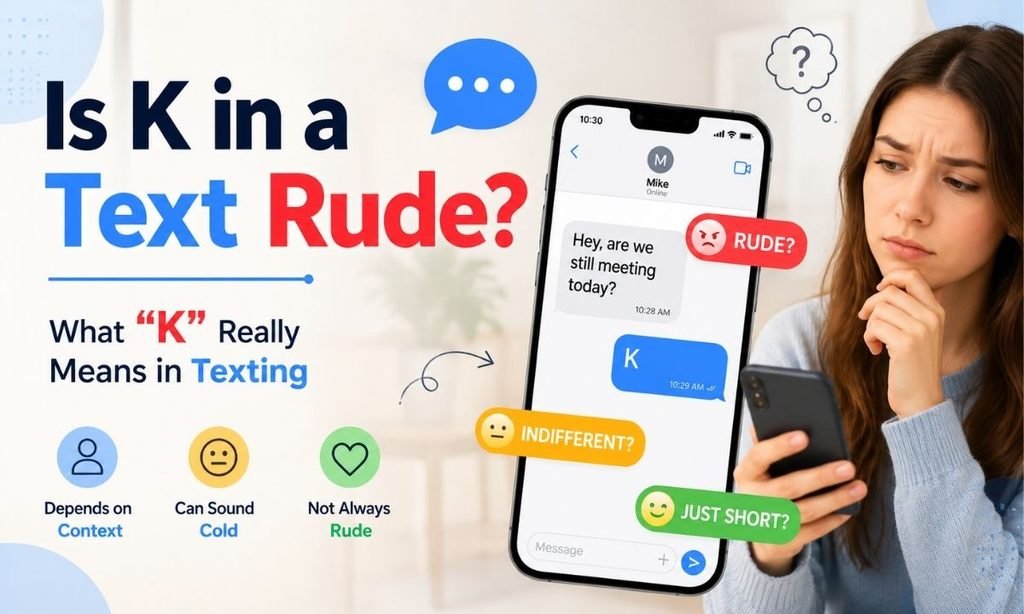
A single K is not automatically rude, but it frequently gets read that way, especially in emotionally loaded conversations. Several studies and countless online discussions describe K as one of the more polarizing replies in texting culture, sitting somewhere between neutral and cold depending on context.
K tends to feel completely fine when:
- It follows a quick, low stakes question
- Both people usually text in short bursts
- The conversation is casual and moving fast
K tends to feel cold or dismissive when:
- It replies to a long or emotional message
- It follows an argument or tense exchange
- It arrives after the other person put in visible effort
How to Tell What K Really Means in a Conversation
Reading K accurately means looking at the whole conversation rather than the single letter itself. A few reliable signals include:
- The message that came right before it
- Whether the sender normally texts in short replies anyway
- Whether the overall conversation felt friendly or tense
- Extra punctuation, emojis, or lack of either
- The relationship and history between both people
Avoid jumping straight to “they’re mad at me” the moment you see a lone K. Many people genuinely text this way with everyone, all the time, regardless of mood.
K vs K. vs KK vs K!: What Is the Difference
Small variations of the same letter can completely change how a reply feels. Here is how each version typically comes across.
| Version | Common Interpretation |
| K | Neutral to slightly cold, depends on context |
| K. | Often read as blunt or annoyed because of the period |
| KK | Friendlier and more casual, feels engaged |
| K! | Upbeat and enthusiastic, clearly positive |
| K… | Suggests hesitation, sarcasm, or unresolved tension |
K Meaning Based on Who Sent It
People often search for what K means specifically from a girl, a guy, a crush, or a partner, because the same letter can carry different emotional weight depending on the relationship.
From a friend, K is usually just a fast, casual acknowledgment with no hidden meaning. From a romantic partner or crush, K can feel more loaded, especially after a serious question or during a disagreement, since the brevity may read as distance. From a coworker, K is typically neutral and simply confirms a task or message was received.
K Meaning in Different Types of Text Conversations
The same letter shifts meaning depending on the setting it appears in.
- Between friends, K is usually light and casual
- From a dating partner, K can feel more emotionally significant
- During an argument, K often signals frustration or a desire to stop talking
- In a group chat, K usually just moves the conversation along
- At work, K can feel too casual or even curt for formal messages
What Does K Mean on Social Media
K shows up across nearly every platform, though its tone can shift slightly by app. On Snapchat and Instagram, K often appears as a quick reply to stories or messages, usually neutral. On WhatsApp, K frequently replaces a full “okay” in fast back and forth chats.
On TikTok and Discord, K sometimes gets used sarcastically or as a dismissive one word comment, closer to internet humor than a genuine acknowledgment.
Related Post: BB Meaning in Text: What Does BB Really Mean in a Message
Cultural and Generational Differences in Reading K
Younger texters and older texters do not always interpret K the same way. Someone who grew up chatting on early instant messengers may see periods and single letter replies as completely normal, simply a fast and efficient habit.
Someone who grew up primarily texting on smartphones may read the same reply, especially with a period attached, as clipped or passive aggressive.
This generational gap explains why the exact same message, a plain K, can spark completely different reactions depending on who sends it and who receives it.
When Does K Mean Okay, and When Does It Mean Something Else
K usually falls into one of these categories:
- A simple acknowledgment with no emotional weight
- Genuine agreement with a plan or suggestion
- A quick reply from someone who is busy
- A signal that the conversation is wrapping up
- A subtle sign of frustration or emotional distance
Context almost always makes the intended meaning clear once you step back and look at the full exchange rather than the single letter.
Real Text Examples of K and What They Mean
Seeing K inside real conversations makes its meaning easier to judge.
Example one, a friendly reply: “Movie starts at 7, meet you there.” Reply: “K, see you soon.” This reads as relaxed agreement with no tension at all.
Example two, after an argument: “I really needed you to show up today.” Reply: “K.” This version often signals hurt feelings or a refusal to keep discussing the issue.
Example three, during a busy moment: “Running five minutes late.” Reply: “K.” This is typically a fast, practical acknowledgment with zero hidden meaning.
Psychology Behind Why Short Replies Feel Cold
Human communication relies heavily on tone of voice, facial expression, and pacing, none of which exist in a text message. When a reply shrinks down to a single letter, the brain often fills that missing emotional information with negative assumptions, especially if the sender already feels uncertain about the relationship.
This is part of why “dry texting,” short low effort replies like K, Fine, or Sure, tends to get interpreted as distant even when no distance was intended.
How to Respond When Someone Texts K
If a K feels neutral, there is usually no need to respond at all, or a simple acknowledgment is enough. If a K feels cold or unexpected, a light follow up question such as asking if everything is okay can clear up confusion quickly without sounding accusatory. Overanalyzing a single letter rarely helps, since many people simply text that way out of habit.
Related Post: What Does RMB Mean in Text? Meaning, Examples & How to Use It
K in Professional and Workplace Messaging
In workplace chats, K can come across as too casual or even slightly curt, particularly in messages to managers, clients, or people outside your immediate team.
A fuller word such as “Okay,” “Got it,” or “Noted” tends to read as more professional while still being quick to type. Reserve a plain K for internal, informal exchanges with close coworkers who already text that way.
Better Alternatives to Sending Just K
If you want to avoid any risk of sounding cold, a few slightly longer options keep things warm while staying just as fast to send:
- OK
- Okay
- Got it
- Sounds good
- Sure thing
- Okay, thanks
- KK
Each of these takes only a second longer to type but noticeably softens the tone compared to a bare K.
Is K an Acronym or Abbreviation
K is not a true acronym, since it does not stand for a phrase made of multiple words. It functions instead as a phonetic abbreviation, representing the sound of the first letter in “okay.” Over decades of texting shorthand, “okay” shortened to “OK,” which then shortened further to the single letter K once speed and habit took over.
K Meaning as Thousand: 10K, 50K and 100K
Outside of texting replies, K commonly stands for thousand, borrowed from the metric prefix kilo. You will see this constantly in phrases like 10K followers, a 50K salary, or a 100K giveaway. This numeric use has nothing to do with agreement or acknowledgment and should never be confused with the standalone reply version of K.
K also appears as the scientific symbol for the element potassium and as the abbreviation for Kelvin, the temperature scale used in physics and chemistry. These technical meanings sit completely apart from texting slang and only apply in scientific or measurement contexts.
Common Mistakes When Interpreting K in a Text
- Assuming K always means someone is angry
- Treating every short reply as automatically rude
- Ignoring the rest of the conversation for context
- Overanalyzing a single message instead of the overall pattern
- Forgetting that some people simply text in short replies with everyone
Frequently Asked Questions
What does K mean from a girl in text?
It usually still means okay, though tone and prior messages matter more than the sender’s gender.
What does K mean from a guy in text?
Same core meaning as usual, simple acknowledgment, though it can feel curt during emotional conversations.
Does K mean someone is mad?
Not necessarily. It can signal mild frustration, but many people send it with zero negative intent.
Is K rude in texting?
Not inherently, though it often reads as blunt or dismissive in sensitive or emotional conversations.
What is the difference between K and KK?
KK generally feels warmer and more engaged, while a single K can feel flatter or more neutral.
What does K. with a period mean?
The added period often makes the reply feel more final, blunt, or slightly annoyed.
Should I reply after someone says K?
Usually not required, though a quick follow up is fine if the reply felt unexpectedly cold.
What does K mean after a number?
After a number, K stands for thousand, such as 10K meaning ten thousand.
Conclusion
K usually means okay or I understand. Its emotional tone depends on the conversation, the sender’s normal texting style, punctuation, and the relationship between the people involved. A single K does not automatically mean someone is angry, and reading the full exchange will almost always tell you more than the letter alone ever could.