

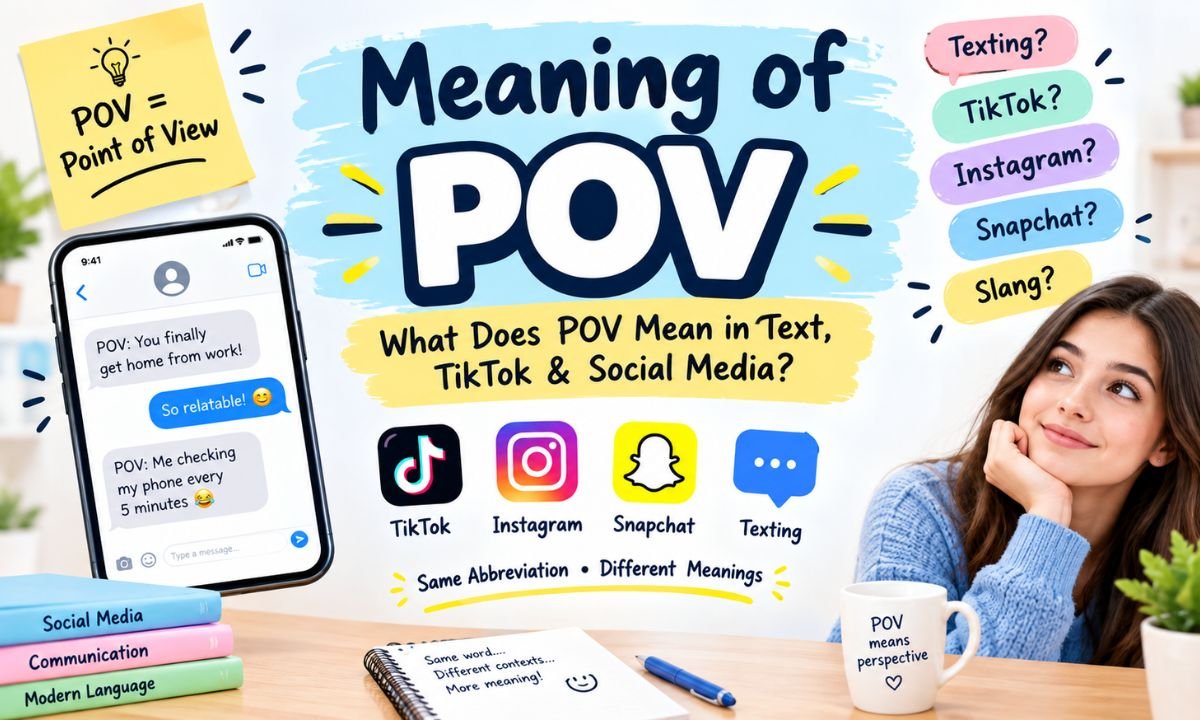
POV is one of those short internet abbreviations that shows up everywhere, from a friend’s text message to a viral TikTok caption, yet its exact meaning shifts slightly depending on where you spot it.
At its core, POV stands for “point of view,” a term borrowed from film and literature long before social media picked it up.
This guide breaks down what POV means in plain conversation, how it works in texting, and why platforms like TikTok, Instagram, and Snapchat have turned it into a full storytelling format. You’ll also find real examples, reply ideas, and quick-reference tables you can scan in seconds.
What Does POV Actually Stand For?
POV is short for “point of view.” In its simplest form, it describes the angle, perspective, or vantage point from which a person sees, experiences, or narrates something. This meaning has existed in film, photography, and writing for decades, long before it became internet shorthand.
- P – Point
- O – Of
- V – View
When someone uses POV in casual conversation, they are usually flagging that what follows is their personal take, or that they want you to picture a specific scene through someone else’s eyes. It is a compact way to set a scene without writing a full paragraph of context.
POV Meaning in Text Messages
In texting, POV usually works as a scene-setter rather than a literal opinion statement. Someone types “POV” followed by a short situation, and the reader is meant to imagine themselves living through it.
This format is popular because it turns a flat statement into something relatable and almost cinematic in just a few words.
Common ways POV shows up in texts:
- Setting up a relatable situation (“POV: it’s Monday and your alarm didn’t go off”)
- Introducing a joke or exaggerated scenario
- Framing a complaint or frustration in a lighthearted way
- Sharing a personal feeling without writing it out directly
Quick text examples:
- “POV: you finally get home after a 12-hour shift.”
- “POV: you’re pretending to listen but you’re actually thinking about food.”
- “POV: your group chat notifications hit triple digits overnight.”
POV Meaning on TikTok
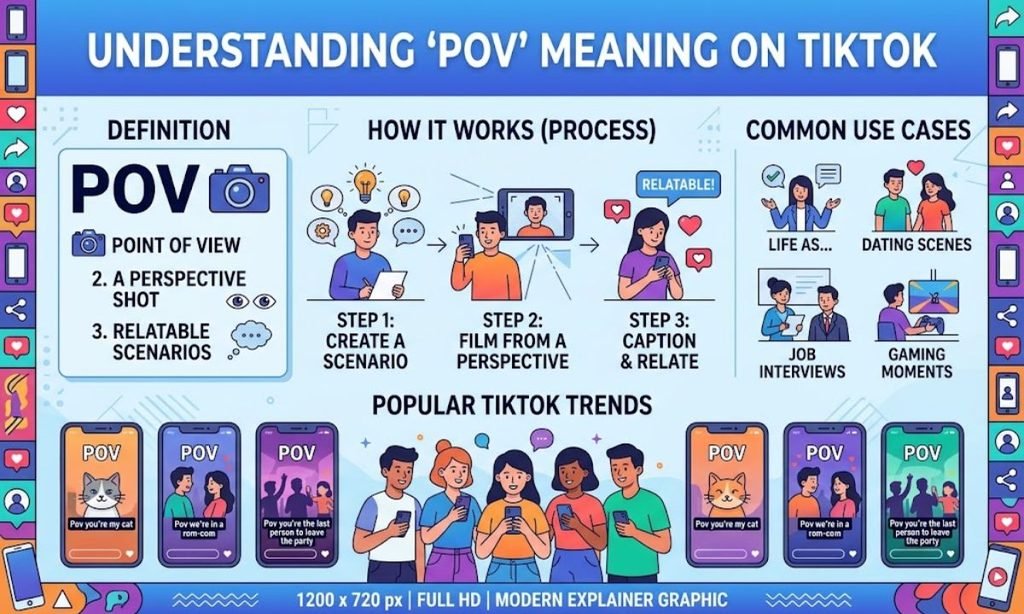
TikTok is largely responsible for turning POV into a full content category rather than just an abbreviation. A POV video places the viewer directly inside a scenario, often shot from a specific character’s perspective, whether that’s a nosy coworker, an overprotective parent, or even an inanimate object.
Not every POV video is filmed literally through someone’s eyes. Many creators act out a role while the caption tells you who you are supposed to be watching, or imagining yourself as, during the clip. This role-play structure is what makes POV content so shareable and easy to remix across trends.
Reasons POV content performs well on TikTok:
- It invites the viewer to participate emotionally rather than just watch passively.
- It works for comedy, storytelling, relationship skits, and even educational content.
- It’s a flexible format that fits nearly any trending sound or challenge.
POV Meaning on Instagram
On Instagram, POV shows up most often in Reels captions, carousel posts, and comment sections. The intent is similar to TikTok, framing a scenario for the viewer, but Instagram’s version leans more toward humor, relatable everyday moments, and aesthetic storytelling rather than character-driven skits.
A typical Instagram caption might read: “POV: you said you’d only buy one thing at the store.” The image or video then shows the punchline. In comments, POV can also introduce a lighthearted observation about the post itself.
POV Meaning on Snapchat
Snapchat’s use of POV is more personal and momentary, matching the platform’s disappearing-content style. In direct snaps, POV often frames a quick reaction or a funny “in the moment” situation shared with a close friend rather than a public audience.
In Snapchat Stories, POV tends to mirror TikTok and Instagram trends, short scenarios meant to be relatable or funny, just shared with a smaller, more private circle of viewers.
How POV Is Used Across Social Media
Across platforms, POV generally falls into three overlapping categories:
- POV as a scenario – setting up an imagined situation for the viewer to picture themselves in
- POV as perspective – describing whose eyes or experience the content is being told through
- POV as an opinion – a shorthand way of saying “from where I stand” or “in my view”
The traditional meaning, perspective, still anchors all of these. What has changed is how creatively the term gets applied online, stretching from a simple viewpoint into an entire storytelling device.
Is POV Considered Slang?
POV is not slang in the way made-up internet words are. It is a long-established abbreviation that has simply expanded its usage.
What started as film and photography terminology has been absorbed into casual digital communication, picking up new shades of meaning along the way without losing its original definition.
Calling it exclusively “Gen Z slang” oversimplifies things. People across age groups now use POV in texts, captions, and even workplace chats, which shows how mainstream the abbreviation has become rather than how niche it remains.
POV in Everyday Contexts Beyond Social Media
POV shows up well outside of texting and short-form video too:
- Writing and literature – narrative point of view (first-person, second-person, third-person) determines whose eyes tell the story
- Film and photography – a POV shot shows exactly what a character sees, often used to build immersion
- Gaming – many games let players switch to a first-person POV for a more immersive camera angle
- Everyday conversation – “from my POV” is simply a casual stand-in for “in my opinion”
The History and Origin of POV
The abbreviation POV predates the internet by decades. Filmmakers and photographers used “point-of-view shot” to describe camera angles that show the audience exactly what a character sees, a technique that dates back to early cinema.
Novelists and writing teachers have used “point of view” just as long to describe narrative voice.
Social media didn’t invent the term; it repurposed an existing filmmaking concept and applied it to caption writing. That borrowed cinematic quality is part of why POV captions feel so immersive, they’re using a storytelling trick that has worked on audiences for over a century.
POV in Business and Professional Communication
POV also appears in more formal settings, particularly in workplaces and marketing. A “POV document” or “POV deck” in business usually means a short write-up presenting someone’s professional opinion or strategic angle on a problem, often used by consultants, marketers, or product teams before a bigger proposal.
In everyday work chat, “what’s your POV on this?” is simply a casual way of asking a colleague for their honest take or recommendation, without needing a lengthy formal explanation.
Common Mistakes People Make With POV
A few mix-ups come up often when people first encounter the term:
- Assuming every POV video is filmed literally through someone’s eyes, when many are simply role-play scenarios
- Confusing POV with a direct synonym for “opinion” in every context, when it often introduces a scenario instead
- Overusing POV in writing where a simple description would read more naturally
- Treating POV as brand-new internet slang instead of a decades-old film and writing term
POV in Memes and Internet Culture
Memes have leaned heavily on the POV format because it front-loads context in a single word. Instead of explaining a joke, a meme captioned “POV” hands the entire setup to the image or video, letting the audience fill in the punchline themselves.
This economy of words is a big reason the format spread so quickly across meme pages, group chats, and comment sections.
POV Examples in Real Conversations
| Situation | Example POV Text |
| Relatable frustration | “POV: your Wi-Fi cuts out mid-video call.” |
| Friend group humor | “POV: you’re the one who always picks the restaurant.” |
| Workplace moment | “POV: it’s 4:59 PM on a Friday.” |
| Social media caption | “POV: you just remembered an embarrassing thing from 2019.” |
| Everyday text | “POV: you’re waiting for a text back that never comes.” |
How to Reply When Someone Sends You a POV
Replying to a POV text or caption is usually casual and playful rather than literal. A few natural options:
- Funny reply: “This is way too accurate.”
- Casual reply: “Stop, this is literally me.”
- Agreeing reply: “Facts, I feel this in my soul.”
There’s no strict rule for replying to POV content; the goal is simply to show you understood the scenario and can relate to it.
POV vs Perspective vs Opinion
| Term | What It Really Means | Typical Use |
| POV | Point of view; often introduces a scenario or viewpoint | Texts, captions, casual chat |
| Perspective | The specific angle or lens someone views something from | Writing, discussions, debates |
| Opinion | A personal judgment or belief about something | Formal or casual statements of belief |
While the three terms overlap, POV is the most flexible, capable of meaning a literal camera angle, a narrative choice, or a quick stand-in for “in my opinion,” depending entirely on context.
Is POV the Same as “In My Opinion”?
Sometimes yes, sometimes no. When someone writes “from my POV,” they typically do mean “in my opinion.”
But when POV appears at the start of a caption followed by a scenario, it’s functioning as a storytelling setup rather than a direct opinion statement. Context, not the abbreviation itself, decides which meaning applies.
Is POV Still Common in Texting and Social Media Today?
POV remains one of the most consistently used abbreviations across texting and social platforms. It hasn’t faded the way some short-lived internet trends do, largely because it’s rooted in an established media concept rather than a passing meme.
Expect to keep seeing it in captions, texts, and comment threads for the foreseeable future.
Frequently Asked Questions
What does POV mean in texting?
POV means “point of view” and usually introduces a relatable scenario or personal perspective in a text.
What does POV stand for?
POV stands for “point of view,” a term originally used in film, photography, and writing.
What does POV mean on TikTok?
On TikTok, POV places the viewer inside a scenario or role, often acted out by the creator.
What does POV mean on Instagram?
On Instagram, POV usually sets up a relatable caption or scenario for Reels, posts, or comments.
Is POV slang?
Not exactly; it’s a long-standing abbreviation whose casual online usage has simply expanded over time.
What does POV mean from a girl or guy?
The meaning doesn’t change by gender; it depends entirely on the scenario or context someone is describing.
How do you use POV in a sentence?
Start with “POV:” followed by a short scenario, like “POV: you just missed the bus by ten seconds.”
What is the difference between POV and perspective?
POV is the shorthand term, while perspective describes the actual angle or lens behind that point of view.
Conclusion
POV means “point of view.” In everyday texting and across social media, it commonly introduces a scenario, a personal perspective, or a quick opinion, and its exact sense depends on the platform and sentence it appears in.
Whether you spot it in a text from a friend, a TikTok caption, or a work chat, the underlying idea stays the same: someone is inviting you to see something through a specific lens.