


Someone texts you “PMO” and you freeze. Are they asking for a favor, venting about a bad day, or sending you a work term? Three letters can point in very different directions. You are not alone, since this abbreviation confuses plenty of people at first.
In texting, PMO most often means “put me on” or “pissing me off.” In an office, it stands for “Project Management Office.” The right reading depends entirely on the conversation around it. Context, tone, and the sender decide which meaning fits.
This article explains every meaning, shows real chat examples, and gives you simple tips for replying. By the end, you will know how to read PMO correctly and avoid awkward mix-ups. Let’s break it down step by step.
What Is the Meaning of PMO in Text? Quick Answer
PMO in text usually means “put me on” (introduce me to something good) or “pissing me off” (annoying me). In business, PMO stands for “Project Management Office.”
Here is the fastest way to tell them apart:
| Meaning | Full Form | Clue in the Message | Example |
| Slang request | Put me on | Followed by a topic like music, shows, or people | “PMO to some new playlists” |
| Slang complaint | Pissing me off | Describes something irritating | “This traffic is PMO” |
| Business term | Project Management Office | Appears in work emails or meetings | “Send it to the PMO” |
Where PMO Came From: Origin and Background
The business meaning came first. Companies have used “Project Management Office” for years to describe the team that sets standards and tracks projects. Many workplaces still use it every day.
The slang meanings grew from online chat culture. Short acronyms became popular because they are fast to type on phones. PMO fit that pattern, and people began giving it casual meanings that match everyday feelings.
“Put me on” comes from a longer slang tradition. To “put someone on” means to introduce them to something valuable, such as a song, a brand, or an opportunity. That phrase was already common in music and street culture before it was ever shortened to three letters.
Timeline Overview
No one can name an exact date or inventor for PMO, so this is a general picture of how it spread:
- Early workplace use: PMO appears as a standard office and project term.
- Chat and forum era: Users shorten annoyed phrases into quick acronyms.
- Social media growth: “Put me on” requests spread through music and trend communities.
- Short-video era: TikTok, Instagram, and Snapchat make PMO a common way to ask for recommendations.
Why It Became Popular
Several simple reasons explain its rise:
- Speed: Three letters are quicker than a full sentence.
- Flexibility: One abbreviation covers a request and a complaint.
- Community feel: Asking someone to “put you on” feels friendly and inclusive.
- Shareable culture: Recommendations travel fast on social platforms.
Its flexible nature is also its biggest weakness. Because one acronym carries several meanings, readers must rely on context.
That is why smart texters add a small clue. A song title, an emoji, or a short follow-up sentence helps the reader choose the right meaning on the first try.
Real-Life Conversations With PMO

Seeing PMO in action makes each meaning easier to spot. These examples are original.
WhatsApp Chat: Discovering Something New
Nina: I’ve watched everything on my list. PMO to a good thriller.
Zoya: Try the one about the missing hiker. You’ll finish it in one night
Nina: Downloading it now!
Nina uses PMO as “put me on.” She wants a recommendation, and Zoya gives one.
Instagram DM: Asking for a Connection
Ray: Your photos are amazing. PMO to your editing app?
Kai: Thanks! It’s free, I’ll send you the name.
Here PMO asks to be shown something specific. It sounds polite because the compliment comes first.
Text Message: Expressing Annoyance
Ben: My neighbor started drilling at 7 a.m. again. It PMO so much.
Chris: Ugh, that’s the worst. Want to grab breakfast somewhere quiet?
Ben means “pisses me off.” The complaint is clear from the situation, and Chris responds with sympathy.
Snapchat Chat: Reacting to a Friend’s Snap
Mia: sends a photo of a delayed flight board PMO 😤
Lily: Noooo, how long is the delay?
In this case, the photo and the angry emoji make the meaning obvious. Snapchat chats often rely on images and emojis to carry tone.
TikTok Comments: Sharing Recommendations
User A: This song is a vibe. PMO to more artists like this!
User B: Check out the indie playlist I posted, you’ll love it
Creators and fans use PMO in comments to ask for similar content. It often leads to helpful replies and new follows.
Notice how the request stays specific. “More artists like this” gives other users something clear to answer, which is why detailed asks get better replies than a lone “PMO.”
Takeaway: Look at what comes right before and after PMO. The surrounding words almost always reveal the meaning.
The Emotional and Psychological Meaning of PMO
PMO can sound completely different depending on the feeling behind it.
When it means “put me on,” the emotion is usually curiosity, excitement, or trust. The sender is saying, “I value your taste, so share it with me.” That is a small compliment in itself.
When it means “pissing me off,” the emotion shifts to irritation, stress, or frustration. The sender may simply be venting, not blaming you.
Here are signals that help you read the mood:
- A topic follows PMO (“PMO to new shows”): curious and friendly
- An angry emoji appears (😤, 😡): annoyed
- A laughing emoji appears (😂): playful complaint
- A question mark follows: a polite request
- All caps (PMO!!): strong emotion, positive or negative
Because texting lacks voice and facial expressions, readers often fill in tone themselves. Checking small details keeps you from reacting to the wrong feeling.
Timing matters as well. A “PMO” sent during a stressful workday is more likely a complaint, while one sent on a quiet weekend evening is often a request for something to watch or listen to.
How PMO Is Used in Different Contexts
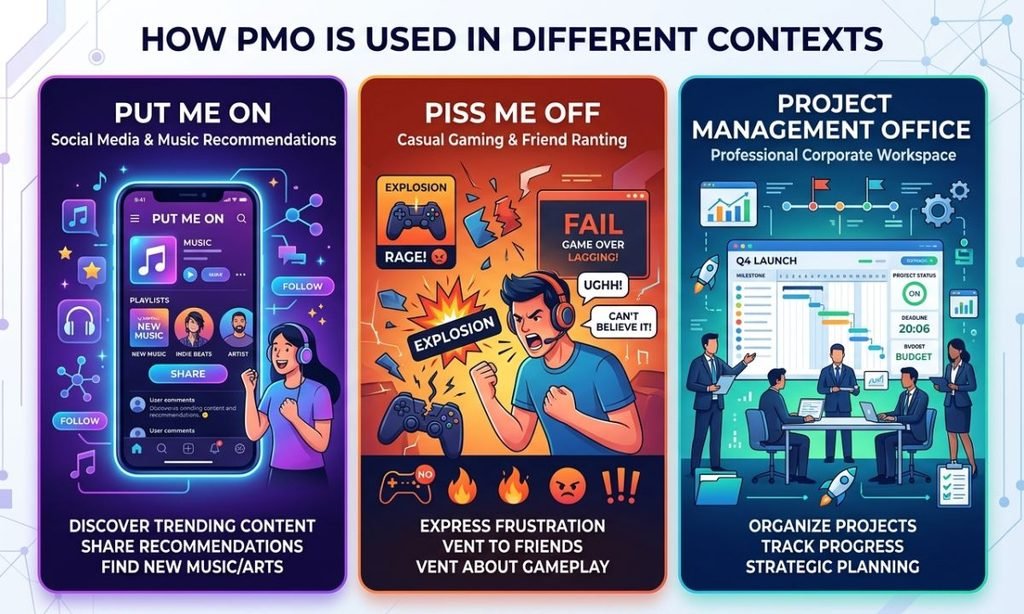
PMO on Social Media
On public platforms, PMO is mostly a request for content. People ask for music, creators, brands, recipes, or study tips.
It also appears in complaints under videos or posts, such as “Slow Wi-Fi PMO.” Since strangers see these comments, a clear follow-up like “PMO to new podcasts” prevents confusion.
Creators often reply to these comments with lists, links, or short video answers. If you ask politely and name your taste, you are far more likely to get a thoughtful reply.
PMO Among Friends and in Relationships
Friends use PMO freely because they already know each other’s style. A friend asking you to “put me on” to a new game feels like a compliment on your taste.
In relationships, context matters more. “PMO” after an argument may sound sharp, while “PMO to your favorite songs” feels sweet and curious. If a partner uses it as a complaint, check whether the annoyance is about you or the situation.
For example:
- “PMO to your childhood favorites, I want to know you better” → loving and curious
- “Your late replies PMO” → direct complaint that deserves a calm talk
PMO in Work and Professional Settings
At work, PMO almost always means “Project Management Office.” A manager might say, “Please share the report with the PMO by Friday.”
Slang meanings do not belong in emails to clients, bosses, or teachers. If a colleague uses the casual version in a friendly team chat, match their style only when you are sure they are comfortable with it.
PMO Meaning in Slang: “Put Me On”
“Put me on” is the friendliest meaning. It asks someone to introduce you to something new that they already know and love.
People say it about:
- Music: “PMO to some chill playlists”
- Shows and movies: “PMO to a good comedy”
- Brands and products: “PMO to affordable skincare”
- Opportunities: “PMO to any remote jobs you hear about”
Here is a short exchange:
Sara: PMO to some good study playlists.
Dev: Try the lo-fi mix I’ve been using. It helps me focus.
Why is it popular?
Asking for a recommendation shows trust, and people enjoy sharing what they love. It also saves time, because you get a trusted suggestion instead of searching alone.
PMO Meaning in Slang: “Pissing Me Off”
The second slang meaning is a complaint. It expresses annoyance, frustration, or anger about a person or situation.
Common uses include:
- “This homework is PMO.”
- “People who talk during movies PMO.”
- “Why does my phone keep freezing? It PMO!”
The wording is informal and a little rude, because it includes a mild swear word. Use it with close friends, not in polite or professional settings.
Tone also changes the effect. Said with a laughing emoji, it can sound lighthearted. Said alone in an argument, it can sound harsh. 😤
If the message targets you directly, such as “You PMO,” take it seriously and talk calmly. If it is about a situation, offer support instead of getting defensive.
PMO Meaning in Business: “Project Management Office”
In business, PMO stands for Project Management Office. It is a team or department that sets project standards, tracks progress, shares best practices, and helps teams deliver work on time.
Typical PMO tasks include:
- Creating project templates and guidelines
- Monitoring budgets and schedules
- Reporting progress to leadership
- Training project managers
You might hear sentences like:
- “The PMO approved the new timeline.”
- “She works in the PMO at a large bank.”
- “Submit your status report to the PMO.”
Because slang and business meanings share the same letters, mix-ups can happen. A joke like “PMO, I’m swamped” in a work chat could confuse a coworker who expects the business meaning.
To avoid this, name the team when you mean the business term. Saying “the project management office” once, then using PMO afterward, keeps everyone on the same page.
Casual vs. Serious Tone
| Setting | Likely Meaning | Is Casual Use Okay? |
| Chat with close friends | Put me on / pissing me off | Yes |
| Social media comments | Put me on | Yes |
| Team chat (relaxed) | Depends, check context | Sometimes |
| Work email or meeting | Project Management Office | Business meaning only |
| Messages to teachers or clients | Not slang | No |
| Serious or emotional talks | Avoid slang | Use full sentences |
Common Myths and Misunderstandings About PMO
Myth1: Assuming It Is Always Negative
Many people think PMO is always rude because of the complaint meaning. In reality, “put me on” is probably the more common use among younger social media users. Always read the full message first.
Myth2: Mixing Up Text Slang and Business Language
Using “PMO” in a work email as a joke can confuse readers or sound unprofessional. On the other hand, treating a friend’s “PMO to new music” as a business request makes the reply feel awkward. Know your audience.
Myth3: Using It When Clarity Matters
When you need a precise answer, such as asking a coworker for help, spell it out. “Could you recommend a good project tool?” is clearer than a short acronym.
A simple rule applies: if a wrong guess could cause trouble, write the full sentence.
For example, if your boss texts “PMO update?” you should assume it means the Project Management Office and reply professionally. Guessing the slang meaning there would be a clear misstep.
PMO vs. Similar Slang Terms
Several abbreviations overlap with PMO in tone or purpose. Here is how they compare.
| Term | Meaning | Tone | Typical Use |
| PMO | Put me on / pissing me off | Casual, mixed | Recommendations or complaints |
| HMU | Hit me up | Friendly | Invite someone to contact you |
| IDK | I don’t know | Neutral | Show uncertainty |
| SMH | Shaking my head | Disapproving | React to something silly |
| TBH | To be honest | Direct | Share an honest opinion |
| FR | For real | Emphatic | Agree or stress a point |
| Rec me | Recommend me | Friendly | Ask for suggestions |
| PMO (business) | Project Management Office | Formal | Work and project settings |
PMO Variations and Related Phrases
PMO appears in many forms. Here are ten you will see often.
1. PMO
The plain form can mean any of the three meanings. Read the context.
2. PMO to…
This is the classic “put me on to…” request. Example: “PMO to a good podcast.”
3. PMO with…
A slight variation, such as “PMO with the best snacks.” It also asks for suggestions.
4. PMO fr
“For real” adds sincerity. Example: “PMO fr, I need new music.”
5. PMO pls
“Please” makes the request polite and gentle. Perfect for new contacts or creators.
6. PMO lol
The “lol” softens the tone. It can sound playful whether it is a request or a mild complaint.
7. That PMO
Here PMO usually means “pissing me off,” such as “That PMO so bad.”
8. It really PMO
A stronger complaint. The word “really” adds emphasis to the frustration.
9. PMO ASAP
Used when someone needs recommendations urgently, like “PMO ASAP, trip is tomorrow.”
10. PMO tho
“Tho” (though) adds a reluctant or contrasting feeling. “It PMO tho, but I’ll deal with it.”
How to Reply When Someone Uses PMO
First decide which meaning the sender intends. Then match their mood. 🙂
Casual Replies
For a “put me on” request:
- “Sure! Try this one, you’ll like it.”
- “Oh I’ve got a list for you, hold on.”
For a complaint:
- “Ugh, same. What happened?”
- “That sounds annoying. I’m here if you want to vent.”
Funny Replies
- “Say less, I’ve got the perfect recommendation 😎”
- “Welcome to the club, we meet at the snack table.”
- “Lucky you asked the right person!”
Mature and Confident Replies
- “Happy to share. Here is what I would start with.”
- “I understand why that is frustrating. What would help most?”
- “Let me think of something that fits your taste.”
Private and Respectful Replies
If the message is personal or comes from someone you do not know well:
- “Could you tell me a bit more about what you’re looking for?”
- “I’d rather talk about this privately. Can we chat later?”
- “Sorry, I’m not comfortable sharing that.”
Quick tip: if the meaning is unclear, ask. “Do you mean put me on, or pissing you off?” costs a few seconds and saves confusion.
PMO Usage Across Regions and Cultures
The abbreviation is English, but communication styles vary.
| Region | Typical Usage | Etiquette Note |
| Western countries | Very common on social platforms | Slang flows freely among friends |
| Asian countries | Common among young English users | Formal greetings preferred with elders |
| Middle Eastern countries | Appears in English or mixed-language chats | Politeness shapes how casual people get |
| Global internet | Understood in many online spaces | Spell it out for mixed audiences |
Western Culture
In the US, UK, Canada, and Australia, “put me on” is widely used in music, fashion, and trend communities. The complaint meaning is also common in casual chats. 🇺🇸🇬🇧
Asian Culture
Younger users often blend English slang with local languages, so PMO appears in comments and group chats. Still, with teachers, relatives, or older colleagues, full, polite sentences are usually the better choice.
Middle Eastern Culture
English abbreviations show up in gaming, social media, and mixed-language conversations. The meaning stays the same, but respect and formality strongly influence tone, so match the other person’s style.
Global Internet Usage
Online communities connect people from every country, and slang spreads quickly. Even so, not everyone knows every acronym, especially one with several meanings. When talking to an international audience, write it out.
Conclusion
PMO is a small abbreviation with a big range. It can ask for recommendations (“put me on”), express frustration (“pissing me off”), or name a business team (“Project Management Office”).
The safest way to decode it is to check the context, emojis, and relationship. Use the slang with friends, keep business meanings for work, and spell things out when clarity matters.
Frequently Asked Questions
What is the meaning of PMO in text?
PMO usually means “put me on” (recommend something to me) or “pissing me off.” In business, it means “Project Management Office.”
What does PMO mean when it comes from a girl or a guy?
The meaning is the same no matter who sends it. Tone, emojis, and context tell you whether it is a request or a complaint.
What does “PMO to music” mean?
It means “put me on to music,” or “recommend me some good music.” The sender wants new songs or artists.
Is PMO a positive or negative term?
It can be either. “Put me on” is friendly, while “pissing me off” is a complaint.
What is the meaning of PMO on TikTok?
On TikTok it most often means “put me on,” as in asking for recommendations. It can also express annoyance in a comment.
What does PMO stand for in business?
It stands for “Project Management Office,” a team that sets project standards and tracks progress.
Is it appropriate to use PMO in professional communication?
Only the business meaning is appropriate at work. Avoid the slang meanings in emails and formal chats.